What is a Nippers carnival?
A carnival is a fun, competition day where Nippers from different clubs come together to test their skills in a range of beach and water events. Carnivals happen at club, inter-club, branch, and state level throughout the season.
They’re exciting, they’re loud, they’re a bit chaotic, and they’re one of the highlights of the Nippers calendar. For many kids, carnival day is the day they look forward to most. For parents, it’s a long morning of sunscreen, cheering, and looking for your child in a sea of coloured caps.
Importantly, competition is entirely optional. The Nippers program is designed around fun, learning, and participation — not winning. Many Nippers never compete at a carnival and that is completely fine. But for those who want to have a go, carnivals are a fantastic way to challenge themselves, experience teamwork, meet kids from other clubs, and feel part of the wider surf lifesaving community.
The most important thing
Carnivals are about participation, not podiums. Every child who puts on their cap, walks to the start line, and gives it a go has achieved something worth celebrating — regardless of where they finish. The kids who come last and keep smiling are showing more character than most adults manage on a weekday. Encourage effort. Celebrate the having-a-go. That’s what this is about.
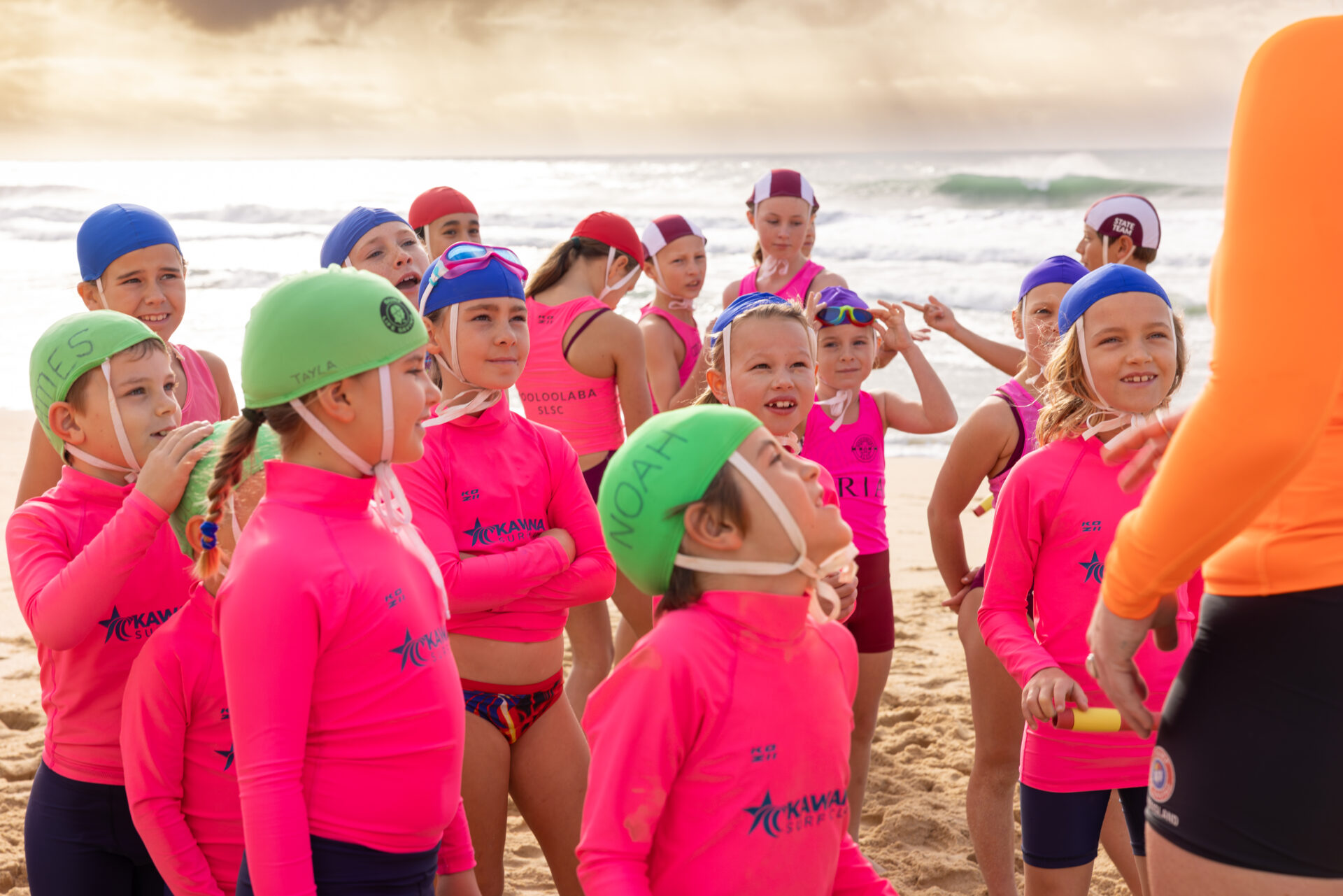
Before your child can compete
There are a few requirements that must be met before a Nipper can enter a carnival. These exist to make sure every child competing is safe and capable in the conditions they’ll face.
Age requirement
Competition begins from U8 (age 7). U6 and U7 Nippers do not participate in any competitive events — their program is focused entirely on fun, social activities, and building water confidence.
Preliminary evaluation
Every Nipper must have successfully completed the two-part preliminary evaluation before they can progress to competition. This includes the initial water evaluation and the beach-based run-swim-run. Both must be completed before a child is eligible to compete.
Competition evaluation
In addition to the preliminary evaluation, Nippers who want to compete must also complete a competition evaluation for their age group. This is an open-water swim based on the competition distances set out in the SLSA Surf Sports Manual for each age group. The swim must be completed using a majority overarm stroke to demonstrate competency in surf conditions. Individual branches may set a higher standard — check with your branch office for confirmation.
Before completing the competition evaluation, the child must have already passed the preliminary evaluation (pool swim and run-swim-run).
Age award
Members wishing to compete in championship events must complete their respective Junior Activities age award before the close of entries for their branch. The age award requires completion of all required education lessons for the age group and a minimum of 50% attendance during the Nippers season.
Age group participation
Children compete in their registered age group. While SLSQ allows Nippers to move down one age group for participation purposes (for reasons such as ability, competency, or social factors), members who have moved down an age group are not eligible to compete.
High-visibility clothing
All Nippers participating in competition or open water activities must wear high-visibility clothing, including a hot pink rash vest (compulsory for competitors), as well as a club cap. Check your club and branch for any additional uniform requirements.
What events are there?
Events vary by age group and carnival level, but they generally fall into the following categories. The SLSA Surf Sports Manual sets out the full list of approved events and distances for each age group.
Beach events
- Beach sprints — short, fast races along the sand
- Beach flags — a reaction and speed game where Nippers race to grab a flag from behind them
- Beach relays — team sprint relays on the sand
Water events
- Wading races — running through shallow water (younger age groups)
- Swim races — open-water swims at distances set for each age group
- Board races — paddling events for older age groups on nipper boards
- Board rescue — team event involving a swim and a board paddle
- Ironperson — a multi-discipline event (swim, board, run) for older age groups
Team events
- Cameron relay — a mixed relay combining a swim leg, a board leg, and a run leg
- All-age relays — various relay formats combining different disciplines
Not every carnival includes every event. Your club or branch will let you know which events are on the program for each carnival day.
For Age Managers: preparing your group
Carnival day is different from a regular Nippers session. It’s bigger, louder, less structured, and your Nippers will be competing against kids from other clubs. Here’s how to set your group up well.
In the weeks before
- Check evaluations are done. Make sure every child who wants to compete has completed both the preliminary evaluation and the competition evaluation. This must be processed through the Nipper App or on paper forms.
- Practise the events. Dedicate a few regular sessions to practising the events your group will face. Run some mock races — beach sprints, flags, wading or swim events. This helps children know what to expect and reduces anxiety on the day.
- Talk about it early. Let parents and children know which carnivals are coming up, what events are available, and what’s required. Give families time to plan.
- Manage expectations. Remind parents and children that carnivals are about having a go. Some kids will win events. Most won’t. Both outcomes are fine. The experience of competing — the nerves, the effort, the teamwork — is what matters.
On carnival day
- Arrive early. Carnivals are busy and logistics take time. Get there early enough to find your club’s area, set up shade, and settle the group.
- Brief your group. Gather the children and explain the order of events, where they need to be and when, and what the rules are. Keep it simple and positive.
- Stay calm. The kids will be excited and possibly nervous. Your energy sets the tone. If you’re calm and encouraging, they will be too.
- Manage the in-between. There’s a lot of waiting at carnivals. Have a few games or activities ready for downtime between events. Keep the group together and hydrated.
- Celebrate everyone. Cheer for every child in every event — not just the ones who place. Acknowledge effort, attitude, and teamwork.
- Hydrate, eat and sun safety. Whilst not your responsibility to pack everyones food and water, ensure that throughout the course of the day everyone is staying hydrated, eating and reapplying sunscreen.
For nervous competitors
Some children will be anxious about competing for the first time. That’s completely normal. Let them know it’s okay to feel nervous. Walk them through the event beforehand so they know exactly what will happen. Stay close to the marshalling area. Remind them that every single person who has ever competed felt nervous the first time.
If a child decides on the day that they don’t want to compete, respect that. They can still be part of the team by cheering, helping, or just being there. Forcing a reluctant child into a race rarely ends well for anyone.
For parents: what to know
What to bring
- Everything from a normal Nippers session, plus extra water and snacks — carnival days are longer
- Your child’s competition rash vest (hot pink high-vis) and club cap
- Sun protection for the whole family — extra sunscreen, hats, a shade tent or umbrella if possible
- A chair and patience — there’s a lot of waiting between events
- A positive attitude, regardless of results
What to expect
Carnivals are organised but they can feel chaotic, especially the first time. Events run across the morning, with children marshalled by age group. There will be officials, arena set-ups, and announcements. Your child’s Age Manager will guide them through the day, but it helps if you know the general flow.
Events are divided by age group. Children are marshalled into their event, compete, and then return to their club area. There are usually individual events (sprints, flags, swims) and team events (relays). Results may be announced on the day or posted afterwards.
How to support your child
- Be there. Your presence matters more than you think. Cheer loudly. Wave from the beach. Be the person they look for when they finish.
- Focus on effort, not outcome. "I saw how hard you tried in that swim" lands better than “why didn’t you win?” Every child who competes deserves recognition for the courage it takes to stand on the start line.
- Keep perspective. This is a children’s surf lifesaving carnival, not the Olympics. The goal is fun, experience, and being part of a team. If your child finishes last and is smiling, that’s a win.
- Don’t coach from the sideline. Let the Age Managers and officials do their jobs. Encouragement from the beach is welcome. Tactical instructions shouted from the dunes are not.
- Thank the volunteers. Carnivals only happen because of volunteers — officials, water safety personnel, marshals, Age Managers, and organisers. A quick thank you goes a long way.
Equipment and uniform guide
This table outlines the standard equipment and uniform requirements for competition. Always check with your club and branch for any additional or specific requirements.
Item |
Details |
| Rash vest | Hot pink high-visibility rash vest is compulsory for all competitors in open water events. Check club/branch and carnival bulletin for additional requirements. |
| Club cap | Must be worn during all events. |
| Bathers/togs | Standard swimwear. Club-branded if required by your club. |
| Nipper board | SLSA-approved boards for board events. Specs for the required board based on age can be found in the Surf Sports Manual. Clubs provide boards in some cases. |
| Stinger suit | Mandatory for all clubs north of Agnes Water (Gladstone region). Long-sleeved rash shirts or stinger suits may be required for beach events. |
| Sun protection | Hat (when not competing), sunscreen SPF 30+ (reapplied every 2 hours), sunglasses. |
| Footwear | Beach sprints and flags are typically barefoot. Check event rules for specifics. |