What does an Age Manager actually do?
If someone at the club has asked you to be an Age Manager — or you’ve put your hand up yourself — you might be wondering what you’ve signed up for. Here’s the honest version.
An Age Manager is the person who leads a group of Nippers through their weekly beach sessions. You’re not expected to be a lifesaving expert, a qualified coach, or a child development specialist. You’re a volunteer who turns up on a Saturday morning, brings a bit of energy, and helps kids have a safe, fun time at the beach while they learn skills that could one day save a life.
In practical terms, your role each week involves welcoming your group of Nippers and their parents, running through a session plan that mixes beach and water activities with games and education, working alongside Water Safety volunteers to make sure everything runs safely, keeping attendance and helping with preliminary evaluations during the season, and being the main point of contact between your age group and the club’s Junior Activities Chairperson (JAC).
You’ll be supported by your JAC, your club’s Water Safety Supervisor, and other Age Managers. You’re not doing this alone — you’re part of a team.
The official bit: To become an Age Manager, you’ll need to be a financial member of your club, be at least 16 years of age, hold a valid Blue Card (if you’re 18 or over), complete the Child Safe Awareness (CSA) and Child Youth Risk Management Strategies (CYRMS) online modules, and complete the SLSQ Age Manager Course. If you’ve held the award before but haven’t been active for five or more years, you’ll need to redo the full course. Otherwise, returning AMs just need to complete the annual proficiency video through SLSA, which automatically updates your accreditation in SurfGuard.
That’s it. Once those boxes are ticked, you’re ready. Everything else — the games, the session structure, the confidence — that all builds week by week. And we’ve built this hub to help you get there.
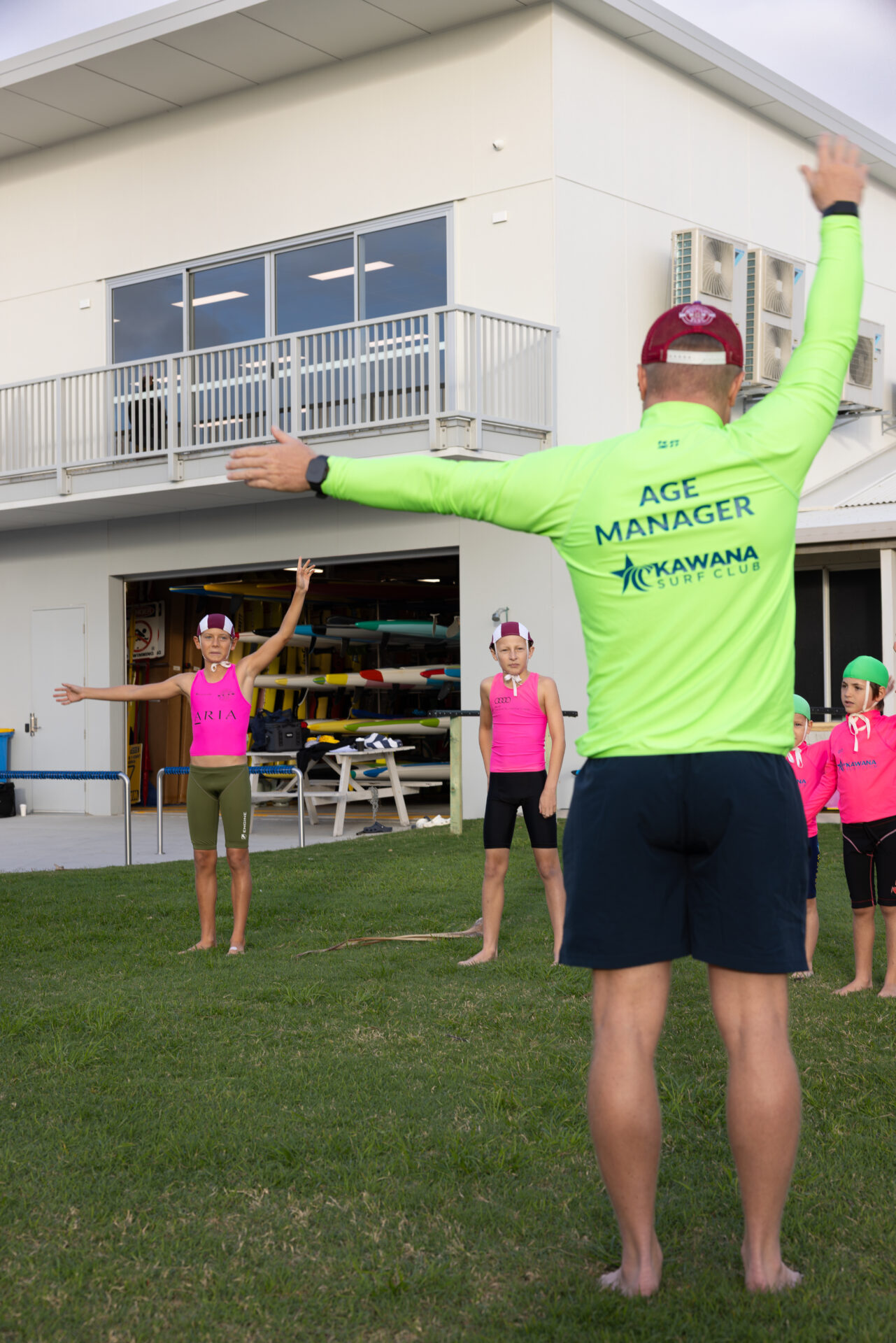
What your first Nippers morning will look like
Your first Saturday can feel like a lot. Here’s a realistic picture of how the morning will flow so you know what to expect.
Before you arrive
Check the weather and surf conditions. If conditions are extreme, your club may cancel or modify the session — your JAC or club communications will let you know. Pack your hat, sunscreen (SPF 30+ minimum, applied at least 15 minutes before sun exposure), water bottle, and your Age Manager lanyard and uniform. Have a loose plan for your session — even if it’s just picking two or three games from the Games Manual.
Arriving at the beach (around 30–45 minutes before the session)
Find your JAC or the Water Safety Supervisor and check in. The Water Safety Supervisor will be completing the Aquatic Risk Check and Management Form — this is the mandatory risk assessment that must be done before any water-based activities start. They’ll assess the surf conditions, current, wind, hazards, and set up the water arenas accordingly. You don’t need to complete this form yourself, but it’s good to know it’s happening and to ask about any conditions that might affect your age group.
Sign on using your club’s system (this might be a patrol logbook, a sign-on sheet, or the Nipper App). Make sure all your Water Safety personnel are signed on too. Help with beach set-up if needed — tents, flags, gear.
Session time (typically 60–90 minutes)
Gather your group. Do a quick roll call using the attendance sheet or the Nipper App. Introduce yourself if it’s early in the season. Give a brief rundown of what you’ll be doing — keep it simple and enthusiastic.
A typical session might include a warm-up activity or game on the sand, a water-based skill or activity (with Water Safety in position — remember the minimum ratio is 1 qualified Water Safety officer for every 5 Nippers in the water), an educational component from the age award curriculum, and a fun game to finish. The recommended on-beach supervision ratio is 2 leaders to 20 participants — ideally one male and one female where possible.
Don’t worry about getting every element perfect. If the water gets closed, pivot to sand games. If the kids are restless, scrap the plan and play something fun. If a child is hesitant about the water, that’s okay — let them participate at their own pace. The Games Manual and our factsheet library are full of ideas for exactly these moments.
Wrapping up
Gather your group, do a quick headcount, thank the parents and Water Safety volunteers, and remind families about next week. Make sure everyone is accounted for before you pack down. If any incidents occurred during the session, report them to your JAC or Water Safety Supervisor.
That’s it. Your first morning is done. It gets easier and more fun every single week.
What a Good Session Looks Like For Age Managers
Your first season checklist
This is your step-by-step guide to getting set up for a great first season. You don’t need to do everything at once — just work through it over the first few weeks. A printable PDF version of this checklist is available to download below.
What to do when things don’t go to plan
Things will go sideways at some point. That’s completely normal. Here are four situations you’re likely to face, and what to do about them.
You’ve got this
Every experienced Age Manager was once exactly where you are now — reading through information, wondering if they’d be any good at it, hoping the kids would listen.
Here’s what they’d tell you: the kids don’t need you to be perfect. They need you to be there. They need someone who’s kind, who makes it fun, and who cares enough to show up on a Saturday morning. That’s already you.
You’ll learn the games as you go. You’ll get better at reading the conditions, managing the group, and thinking on your feet. By mid-season, you’ll wonder why you were ever nervous.
And you won’t be doing it alone. Your JAC, your Water Safety Supervisor, the other Age Managers at your club, and this entire resource hub are here to back you up. If you’re ever stuck, reach out. No question is too small.
You don’t need to be perfect.
You just need to show up.
Ready to explore more? Head back to the Junior Activities Centre for factsheets, games, videos, session planning tools, and everything else you need.