What is Nippers?
Nippers is Surf Life Saving’s program for kids aged 5 to 13. It runs at clubs along the Queensland coastline, usually on Sunday mornings during the warmer months (roughly September through to March, depending on your club).
Each week, children gather at the beach with their age group and a volunteer Age Manager. They play games, learn about the ocean, practise surf safety skills, build confidence in the water, and have a lot of fun along the way. Sessions mix beach activities, water skills, and education — and they’re designed to be age-appropriate, social, and enjoyable for every child, regardless of ability.
Children are grouped by age (U6, U7, U8 and so on through to U14). Your child’s age group is determined by their age as at 30 September each year. The minimum age to join is 5 years old — children cannot participate before they turn 5, as this is an insurance requirement.
What Nippers isn’t
Nippers is not a competitive sport program. While there are optional opportunities to participate in club, regional, and state carnivals later in the season, the program itself is focused on fun, learning, friendships, and building real skills in and around the water. There’s no pressure to compete, and every child participates at their own pace.
It’s also not a drop-off program. At least one parent or guardian is required to stay at the beach while your child is at Nippers. This is for safety and supervision reasons — and honestly, most parents end up enjoying the morning as much as the kids.
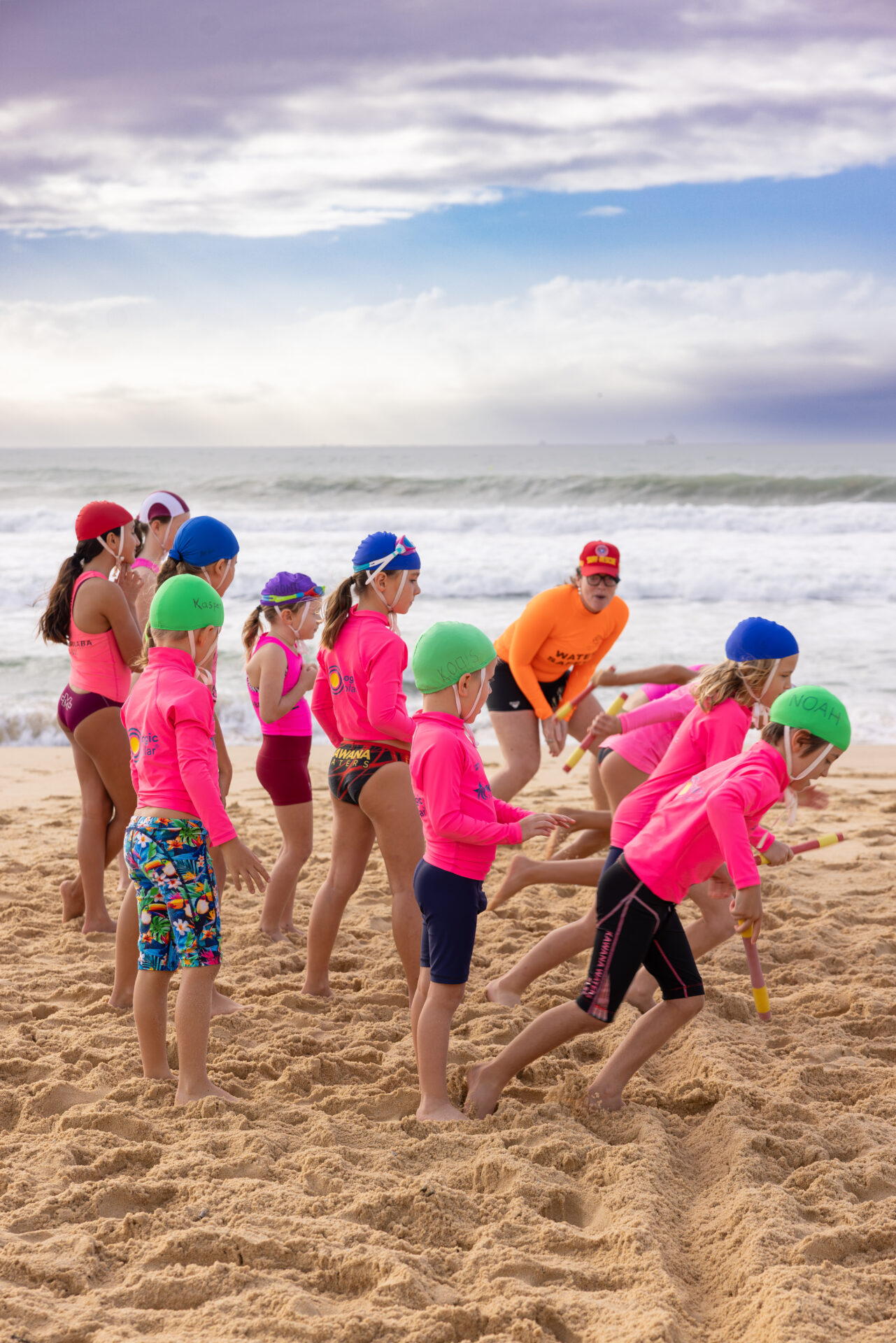
What to bring, what to wear, what to expect
What your child needs each week
- Bathers or togs
- Their club cap (your club will provide or sell these)
- A high-visibility rash vest — this is mandatory for all Nippers participating in water activities and competition events (hot pink is the standard for competitors; your club will advise)
- A long-sleeved rash top for sun protection
- A sun hat for when they’re not in the water
- Sunscreen — SPF 50+ minimum, applied at least 15 minutes before the session
- A water bottle
- A towel
For clubs north of Agnes Water (Gladstone region and above), a stinger suit is also required. Check with your club about any additional local uniform requirements.
What you should bring
- Your own sun protection — hat, sunscreen, and a chair or shade if your club doesn’t provide tents
- Water and snacks for after the session
- A positive attitude and a willingness to get involved (even just cheering from the beach helps)
Signing up
All children must be registered members of the surf lifesaving club before participating. SLSQ recommends that a parent joins alongside their child, though this varies by club. Contact your club for registration details and fees — each club sets its own fee structure. Your child will need to be registered before their first official session (though many clubs offer “Come and Try” days where you can experience Nippers before committing).
What a typical Nippers morning looks like
Every club runs things slightly differently, but here’s a realistic picture of what most Sunday mornings look like so you and your child know what to expect.
Before you arrive
Check your club’s communication channels (Facebook page, group chat, or app) for any updates about the day. If conditions are extreme — very high surf, storms, or excessive heat — the session may be modified or cancelled. Apply sunscreen to your child at least 15 minutes before you leave home.
Arriving at the beach (about 15 minutes before the session)
Head to your club’s usual set-up area. You’ll see tents, flags, and volunteers in uniforms getting things ready. Find your child’s age group — there will usually be signs or a meeting point for each group. Introduce yourself and your child to the Age Manager if it’s your first time. Make sure your child is signed in (your Age Manager will handle attendance).
During the session (usually 60 to 90 minutes)
The Age Manager will gather the group, do a roll call, and explain what’s planned for the day. A typical session includes a warm-up game or activity on the sand, a water-based activity (with qualified Water Safety volunteers positioned in the water — you’ll see them in orange rash vests), an educational component where kids learn about beach safety, ocean awareness, or lifesaving skills, and a fun game.
For the youngest age groups (U6 and U7), sessions are shorter and gentler. Water activities are in shallow water only — generally between the child’s waist and knee height. There’s no competition at all for these age groups — it’s purely about having fun, making friends, and getting comfortable at the beach. U6 and U7 Nippers also wear a distinctive bright cap (such as fluorescent green) so they’re easy to identify.
If the water gets closed during the session because of changing conditions, your child’s Age Manager will switch to sand-based activities. This happens regularly and is a completely normal part of Nippers.
After the session
The Age Manager will gather the group for a final headcount and wrap-up. This is a good time to check in with your child — ask them what they enjoyed, what they learned, and whether they’re looking forward to next week. Keep an eye on club communications for updates about the following session.
How can you help?
Supporting a nervous child
If your child is anxious or hesitant
This is completely normal, especially in the first few weeks. The beach is big, the group is new, and the water can feel intimidating. Here are some things that help:
- Stay close by for the first few sessions. Your presence on the beach is reassuring even if your child doesn’t look at you.
- Talk to the Age Manager before the session and let them know your child is feeling nervous. They’re experienced with this and can adjust how they include your child.
- Don’t force it. If your child doesn’t want to go in the water today, that’s okay. Walking along the water’s edge, playing in the sand near the group, or just watching for a week is all progress.
- Use encouraging language without pressure: “You can try it when you’re ready” rather than “All the other kids are doing it.”
- Celebrate small wins. If they put their toes in the water this week after watching from the sand last week, that’s a big deal.
Be patient. Most nervous kids are running into the waves by mid-season. Confidence builds with familiarity, routine, and trust.
Supporting your Age Manager
Your child’s Age Manager is a volunteer — a parent just like you who has put their hand up to help. They’re giving up their Sunday mornings, learning new skills, and doing their best to make Nippers great for every child in the group. Here are some simple ways you can make their job easier and the experience better for everyone.
- Be on time. Arriving after the session has started means the Age Manager has to re-do roll call and adjust their plan. Even five minutes makes a difference.
- Stay for the whole session. Parents and guardians are required to remain at the beach while their child is at Nippers. This is a safety requirement — if there’s an emergency, an injury, or the session finishes early, you need to be there.
- Keep an eye on your child between activities. Age Managers are responsible for the group during structured activities, but during transitions and breaks, your supervision matters.
- Communicate early. If your child has any needs, concerns, or medical conditions the Age Manager should know about, tell them before the session — not during it.
- Offer to help. You don’t need any qualifications to help with beach set-up, pack-down, gear, or general support. If you hold a Bronze Medallion or Surf Rescue Certificate, you can assist with water safety — and your club will love you for it.
- Raise concerns respectfully. If something doesn’t feel right, talk to the Age Manager after the session or contact the club’s Junior Activities Chairperson. Constructive feedback is always welcome. Challenging a volunteer on the beach in front of the children is not helpful for anyone.
- Say thank you. A quick “thanks for today” at the end of a session goes a long way. Age Managers are volunteers, and knowing their effort is appreciated makes all the difference.
Want to do more?
There are loads of ways to get involved beyond just watching from the beach. Many roles need no qualifications at all — BBQ helper, gear coordinator, canteen support, fundraising, photography (with an SLSQ pass), uniform coordination, or joining the Junior Activities committee.
If you’re keen to take the next step, you can train as an Age Manager, complete your Nipper Safety Assistant, Surf Rescue Certificate or Bronze Medallion for water safety, or become a coach or official. The Nipper Parent page on the Junior Activities Centre has the full list of roles and how to get started.
Every contribution — big or small — helps make Nippers safer, more fun, and more sustainable for every family.
How the season works
Understanding the shape of the season will help you and your child know what’s coming and feel more prepared as the weeks go on.
Welcome to the club
Signing your child up for Nippers is one of the best things you can do for them. They’ll learn skills that could save their life or someone else’s. They’ll make friends. They’ll build confidence. And they’ll spend their weekends at the beach instead of on a screen.
You’re also joining a community. Surf lifesaving clubs are built on families — families who show up, help out, and look after each other. You’ll make friends of your own, you’ll feel part of something meaningful, and you’ll watch your child grow in ways you didn’t expect.