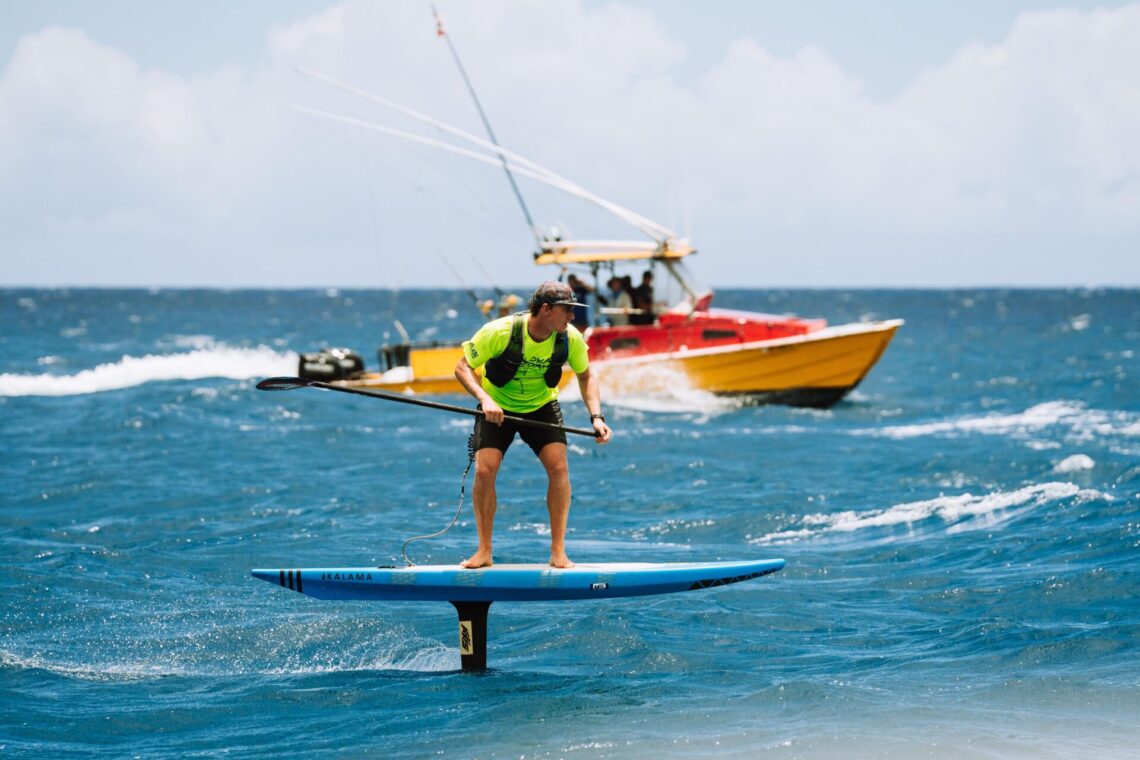
Surf lifesaving has produced generations of exceptional water athletes, shaped by ocean awareness, resilience and discipline. Foiling — now one of the fastest-growing disciplines in water sports — calls on those same foundations, just in a different setting. For Kai Thompson, that setting has carried him from his surf lifesaving roots to racing on the world stage.
“My journey in surf lifesaving started as an Under 9s nipper as a member of Noosa Heads Surf Life Saving Club,” he says.
Like many, he progressed through the full nippers pathway, competing regularly and developing a deep understanding of the surf. While he excelled in beach events —winning Australian titles in sprints and flags— his connection to the water always stood out. He mentions that he has “always loved the water events,” which was the starting point that ultimately shaped his career in foiling.
After trying his friends foil for the first time in 2022, he fell in love with it straight away and purchased his very own the next week.
“I had seen people like Kai Lenny on YouTube foiling and it straight away captured my mind,” he says.
The sensation of lifting above the water and gliding across swell sparked an immediate obsession, and within a year he had progressed into downwind SUP foiling — widely regarded as the pinnacle of the sport.
What Is Foiling — and Why Is It So Demanding?
At its core, foiling changes how athletes move across the ocean.
“A hydrofoil functions like an underwater airplane wing,” Kai explains.
As speed builds, water flowing over the foil creates lift, raising the board clear of the surface and dramatically reducing drag. Once flying, riders can travel faster and more efficiently, gliding across swell rather than pushing through it.
Downwind SUP foiling takes that concept to its extreme. Athletes race long distances using wind and ocean energy, requiring exceptional balance, endurance and the ability to read conditions in real time. It’s a discipline that rewards patience and precision — and one that aligns closely with the skills Kai developed through surf lifesaving.
Those skills were tested early when Kai travelled to Hawaii in 2023 to compete in the Molokai to Oahu World Championships, a 64-kilometre crossing of the Ka’iwi Channel. Known as one of the toughest open-ocean races in the world, it marked a major milestone in his career.
“My performances at these races wasn’t the focus of this trip. I utilised it to learn,” he says. “The experience that came with that month in Hawaii set me up for a very promising future.”
Racing the World — and Adapting to It
That promise has since turned into a breakout international season. Last year alone, Kai competed in ten major events, including the Maui to Molokai, Molokai to Oahu World Championships, Oregon’s Gorge Downwind Challenge, and multiple European stops on the Downwind Foil World Tour. Podium finishes followed, including first-place results in Oregon, Saint-Tropez and Crozon, and top-three finishes in Hawaii.
“Each location has its own conditions and own style of riding,” Kai explains.
Hawaii delivers consistent wind and powerful ocean swell, while France’s conditions are far more unpredictable, often requiring week-long waiting periods before racing can begin. In Western Australia, even seaweed becomes a factor, capable of wrapping around foils and ending races instantly.
“Being able to change and adapt to these conditions requires a lot of training and skill,” he says.
Lining up against the world’s best has been both daunting and motivating for Kai.
“For the last two years I had always idolized the men and women that were on the podiums,” he mentions. “Knowing that I have the ability to compete against my idols is intimidating and it’s extremely exciting.”
Reaching a point where he feels respected among that field has been one of the most rewarding aspects of his journey.
Mindset, Community and the Road Ahead
Preparation for elite foiling extends far beyond race day. Kai balances technical time on the water with land-based training, combining running or cycling with high-intensity gym sessions. Mental preparation is just as critical.
“Visualization is a great tool,” he says. “I spend the day leading into the races visualizing what I want to happen — and what I don’t want to happen.”
By mentally rehearsing difficult scenarios, he’s better equipped to respond when things don’t go to plan.
Despite being an individual sport, community plays a huge role in Kai’s progression.
“Even though I compete alone, I never feel like I’m doing it alone,” he says. “The foiling community is tight-knit… and on the tough days, it’s that same community that keeps you motivated.”
That shared passion, he believes, is what drives constant learning and improvement.
Looking ahead, Kai sees enormous growth potential in the sport.
“The foil scene is expanding faster than almost any other area in watersports,” he says, driven by innovation and accessibility.
His ambition is not just to succeed competitively, but “help to shape the culture — sharing knowledge, pushing limits, and being part of a community that inspires new foilers to join in. If I can help the sport evolve and become more welcoming while continuing to reach new levels personally, then I’ll feel like I’ve played a meaningful role in its journey.”
A Message to Young Athletes
For young athletes curious about giving foiling a try, Kai’s advice is simple and grounded.
“Start with curiosity and patience,” he says, noting that while foiling can feel effortless once you’re flying, getting there takes time. He encourages newcomers to focus on the basics, celebrate small wins and trust the learning process, leaning on experienced riders when needed.
Most importantly, Kai believes having fun is key.
“The learning curve is part of the adventure,” he says — “and that first feeling of lifting clear of the water is worth every wipeout. If you stay open, stay consistent, and stay stoked, foiling can take you farther than you expect.”
It’s a mindset shaped by years in surf lifesaving — one that continues to carry Kai forward, both in and out of the water.