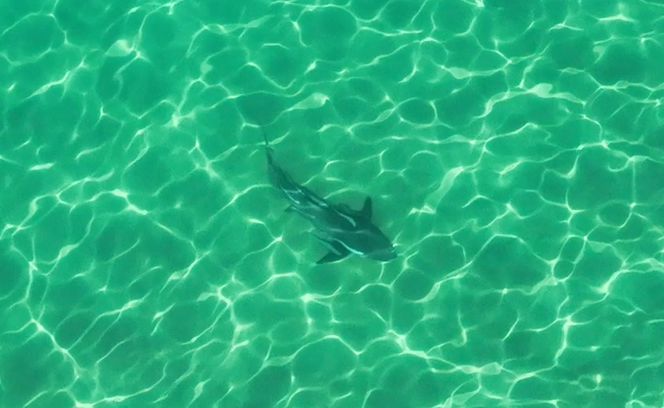
On a busy summer morning now, the patrol setup looks a little different to what many of us grew up with. Flags, boards, IRB… and a hard case with a drone inside, ready to go.
You may have heard a little bit about the Shark Drones operating on Queensland beaches: A Queensland Government sponsored trial, utilising trained SLSQ pilots to survey our waters to help reduce the risk of shark interactions.
The four-year Queensland SharkSmart Drone Trial has recently come to it’s completion and the final report is in – the conclusions are reassuring for anyone who spends a lot of time down the beach and those of us dedicated to keeping people safe between the red and yellow flags.
This isn’t a technical summary. It’s the “what does this mean for us on patrol?” version.
Four seasons, thousands of flights
From 2020 to 2024, SLSQ worked with the Queensland Government to run drones consistently at 10 beaches across the state – from the Sunshine Coast and Gold Coast through to North Stradbroke, Bribie and Rainbow Beach, plus Magnetic Island in the north.
Flights were conducted in the busiest times:
- Weekends, public holidays and every day during school holidays
- From start of patrol until about lunch time
- Set transects behind the surf break, surveilling the flagged area and surrounds
Across those seasons, SLSQ pilots conducted over 28,000 flights, covering more than 7,000 kilometres of coastline. Bad weather unfortunately was the only major limitation to flying.
For Damien Boyer, Head of Uncrewed Aviation, the effort from our dedicated pilots really determined the success of the trial.
“This trial is a major contributor to science, while really contributing to our key priority of keeping the public safe – our professional pilots worked with our volunteer members and dedicated Lifeguards, to work together, in the interest of public safety,” Damien says. “The drones have contributed so much more than just shark spotting. We have been able to assist in major incidents and coordinate our assets, thanks to having a new tool in our arsenal.”
So… how many sharks did we really see?
With that many flights, you might expect the report to be wall-to-wall shark data.
It isn’t.
Across the entire trial, drones recorded:
- Hundreds of shark sighting events, adding up to just under 5,000 individual sharks
- Sharks on only about 4% of all flights
- Sharks were sighted on 676 occasions over the trial period
- 190 sharks over 2m in length were positively identified over four years
- Only 39 water evacuations triggered by drone shark sightings
- The majority of sightings were smaller sharks of non-threatening species
When there were large numbers of sharks, they were usually schooling around big bait balls or clearly feeding offshore, more often then not, away from the majority of swimmers and surfers.
From a risk point of view, that matters.
“While the shark risk is very serious – the likelihood of shark interactions is very rare, and its awesome that we can potentially reduce that risk even more, at our patrolled beaches,” Damien says. “Drones are giving us some extra muscle to maximise our ability to protect the public.”
North Stradbroke Island topped the charts for overall activity – no surprise to anyone who’s watched the water there – but even at “busy” sites, most flights saw no sharks at all.
When and where they show up
The trial also helped pin down some patterns many of us have felt intuitively on patrol:
- Season: More shark activity in summer and autumn, when the water’s warm and there’s often more runoff and bait around.
- Conditions: Sightings went up when the water was clear, glare and wind were manageable, and the tide was high or dropping.
- Company: If the drone picked up bait balls, big schools of fish, rays or dolphins, the chance of sharks being around jumped too.
In other words: if it looks fishy from the tower or the drone, it might be sharky. None of that means panic – but it does mean it’s worth tightening up your risk assessment and making sure everyone on patrol is switched on.
Drones versus nets and drumlines
A key focus of the trial was to better understand how drones perform when used alongside existing shark control measures.
Across the trial beaches, shark nets and drumlines continued to operate as they normally do, while drones provided periodic aerial surveillance. During the same period, drones identified a range of marine life in the patrol areas, including sharks, turtles, rays, dolphins, dugongs and whales.
Unlike traditional shark control gear, drones do not interact physically with marine animals. Their role is purely observational, allowing marine life to move through the area without interference while still improving situational awareness for lifesavers on the beach.
The report does not suggest replacing existing measures. Instead, it highlights that drones can play a valuable, non-lethal role in enhancing visibility and understanding of conditions around the flagged areas.
For Surf Life Saving Queensland, this means more timely and accurate information to support patrol decisions, while continuing to respect and protect the marine environment we operate in
More than shark spotting
Sharks might be the headline, but ask any of the UAV crews and they’ll tell you the same thing: drones are just as valuable as general lifesaving tools.
During the trial, drones were used to:
- Help locate and guide rescues of people caught in rips and currents
- Support police and other agencies in search operations
- Map out gutters, banks and channels up and down the patrol area
After a few flights, pilots and Patrol Captains had a very different mental map of their beach. You can see which rip is really doing the work, how far that gutter runs, where the deeper holes are forming. That insight can change where you put the flags, when you move them, and how you set up for a big day.
What it means for you on the beach
If you’re patrolling at a SharkSmart drone beach – or might be in future – the report really boils down to a few simple messages:
- Risk is low, and we’re getting better at managing it. The drone data backs up decades of patrol experience: serious shark incidents at patrolled beaches are rare.
- Drones make our decisions sharper, not scarier. Instead of reacting to a vague “I saw a fin”, we can see size, behaviour and distance, and make a call with better information.
- Conditions still matter. Warm, clear water and plenty of bait and bird activity are when you expect more action. Combine what you see from the tower, in the IRB and from the drone.
- It’s a team asset, not a solo show. Drones work best when the pilot, Patrol Captain, IRB crew and tower are all talking. Who’s flying, what channel they’re on, and what triggers a flag move or evacuation should all be part of the pre-patrol brief.
Looking ahead – and getting involved
The SharkSmart Drone Trial shows that drones:
- Work in real-world Queensland beach conditions
- Give patrols useful, real-time information about sharks and other hazards
- Support rescues and searches
- Do it all without adding extra risk to wildlife
Most importantly, it shows that SLSQ members can safely and professionally operate this technology as part of normal beach operations.
There’s more work ahead – from exploring AI-assisted shark detection to expanding drone operations where it makes sense – but the foundation has been laid, and it’s red and yellow.
If you’re keen on UAV as a pathway, keep an eye on internal comms for upcoming courses, or have a chat with your Club Captain or Branch Director of Lifesaving.
The short version? The science is in, the data is solid, and it backs up something every lifesaver already knows: when we combine good training, good judgment and the right tools, Queenslanders are in very safe hands – and now, safe eyes in the sky as well.