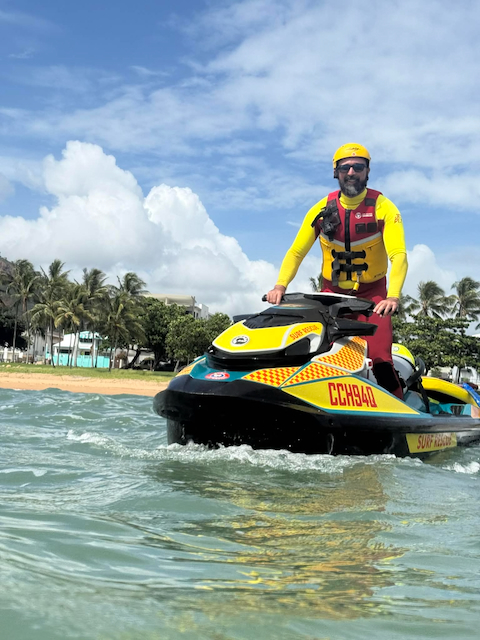
It wasn’t a patrol. It wasn’t even at the beach.
It was early, still dark, and raining when Scott Hayes-Stanley was driving to the gym. Then he spotted something in the road ahead – a high-vis jacket, a motorcycle on its side, and a rider lying nearby.
For newer member Scott Hayes-Stanley, the moment arrived without warning.
At the intersection ahead, traffic lights were about to change.
“Before the lights changed I checked for other traffic and made a turn to block the traffic and switch my hazards on. The decision wasn’t necessarily a conscious one, just that I knew it was necessary.”
What followed was calm, controlled, and instinctive.
Scott stepped out into the rain, flagged down another driver to help direct traffic, and called 000 while moving toward the rider, who still hadn’t moved. Unsure of the rider’s condition, he knelt beside them and began speaking calmly while the emergency operator guided him through questions and assessments.
“The patient opened their eyes and started talking to me about how they felt,” he says.
As the rain continued and daylight slowly appeared, more bystanders arrived to help, including one person who held an umbrella over Scott and the rider while they waited for paramedics. Despite the heavy protective riding gear making assessment difficult, Scott focused on the essentials.
“They were conscious, breathing, and talking to me, so I was able to ask about their details, how they felt and where they felt injury.”
Not long after, a Critical Care Paramedic arrived on scene.
“As they assessed the patient they asked what I did for a profession and it confused me momentarily,” Scott laughs. “I said I was a scientist, but realised they were asking how I knew to respond to the situation. I said I was a surf lifesaver.”
The paramedics later praised the professionalism of the scene management and first aid response. While Scott had completed first aid training before, he credits his Bronze Medallion training with giving him the confidence to act when it mattered most.
“The bronze medallion course definitely assisted in gaining confidence to respond to such an event.”
He describes the experience as surreal.
“It felt as though I just switched gears and that the logical thing was to step in and help. It felt like time stood still yet still moved very quickly.”
That calmness under pressure, he says, came back to the same core principle reinforced throughout surf lifesaving training.
“The focus and priority in that training being patient outcome was a strong thought in the back of my mind.”
For Scott, one of the biggest moments came afterwards, when the feedback from paramedics filtered back through the club.
“Receiving the positive feedback after having to put the skills learnt at Surf Life Saving to use ‘for real’ definitely stuck with me,” he says. “I feel more confident in my ability to assist on and off the beach.”
It’s a confidence that has grown quickly since joining the movement. Despite being a newer member, Scott has already immersed himself in club life, driven by something bigger than patrol hours or awards.
“The people I have met, the strong sense of community, and providing my boys with a pathway to build exceptional life skills,” he says. “I wanted to show it wasn’t just an extracurricular sport but an important personal development pathway. Walking the walk so to speak.”
That sense of contribution and belonging continues to shape his lifesaving journey both on and off the beach.
For newer members wondering whether the training is worth it, Scott’s answer is simple.
“Amazing opportunities. We are so lucky to be able to gain these skills, and on a beach setting.”
Because while most people associate surf lifesaving with red and yellow flags, rescue boards, and weekends on patrol, the skills don’t stay on the sand. Sometimes they appear unexpectedly, in the rain, before sunrise, at the middle of an intersection where someone needed help and another person knew what to do.