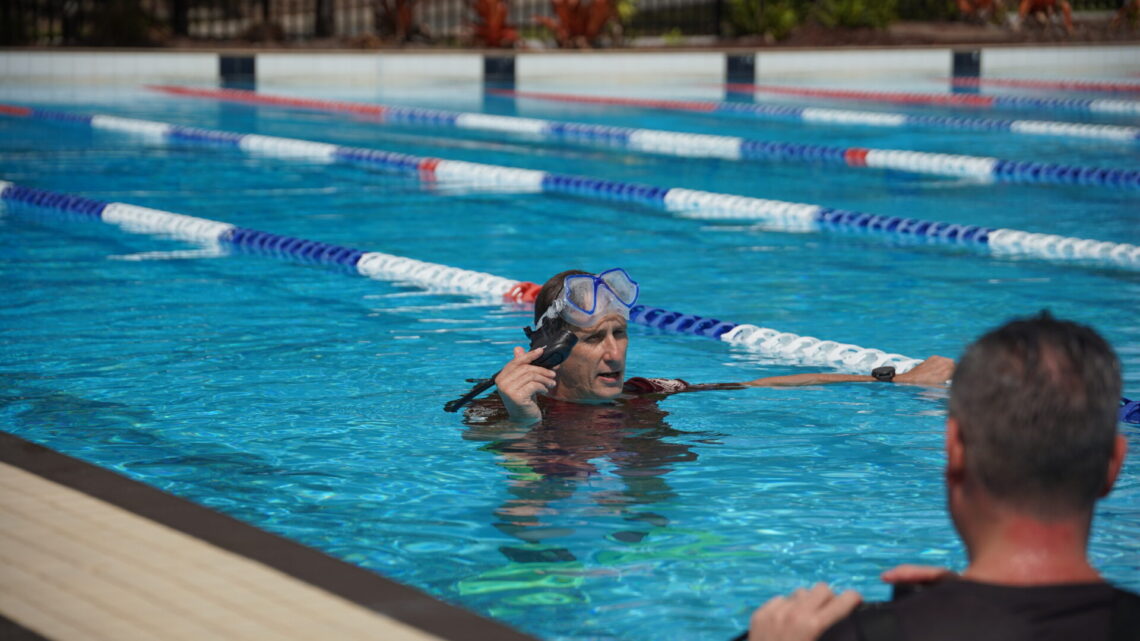
Strapped in, submerged and turned upside down, Helicopter Underwater Escape Training prepares Westpac Lifesaver Rescue Helicopter crews for an emergency they hope they’ll never face.
When most people picture training for the Westpac Lifesaver Rescue Helicopter Service, they might imagine winching from the aircraft, rescue scenarios or hours spent perfecting procedures in the air.
They probably don’t picture being strapped into a simulator, plunged underwater and turned upside down.
But for aviation crews who regularly operate over Queensland’s coastline and waterways, preparing for the unexpected is an essential part of being rescue-ready.
Helicopter Underwater Escape Training, better known as HUET, prepares crew members to safely escape an aircraft following an emergency water landing. The training deliberately places participants in situations involving submersion, inversion and disorientation, teaching them how to overcome their natural reactions and follow a clear escape process under pressure.
According to SLSQ Aviation Crew Training Officer Andrew McNeilly, that’s precisely why the training matters.
“The core rationale for Helicopter Underwater Escape Training is simple and uncompromising: when helicopters ditch or crash into water, survivability depends almost entirely on whether occupants can overcome disorientation, cold shock and time pressure long enough to locate an exit and escape,” Andrew said.
When Instinct Isn’t Enough
A helicopter entering the water can rapidly invert and flood, leaving occupants without their usual visual references and forcing them to locate exits, release restraints and orient themselves while underwater.
In those circumstances, instinct isn’t always helpful.
HUET teaches crews a deliberate sequence of actions: brace, wait, orient, locate an exit, release the harness, escape and surface.
Participants learn to maintain a physical reference point within the aircraft, locate exits by touch, correctly release their harness and navigate their way out when visibility and orientation are compromised.
“The core purpose of HUET scenario-based drills, especially inverted and submerged escapes, is to build automatic, non-instinctive survival behaviours,” Andrew explained.
By repeatedly practising these actions in a controlled environment, crews develop the procedural discipline and muscle memory needed to respond under pressure.
Turning the World Upside Down
During HUET, a simulator introduces participants to many of the physical, sensory and psychological challenges they could encounter during a real water impact.
While the simulator isn’t an exact replica of the aircraft operated by the Service, it exposes crews to critical stressors including inversion, flooding, disorientation and the challenge of finding an exit underwater.
For Andrew, one of the greatest challenges isn’t necessarily the physical act of escaping. It’s overcoming the natural response to the situation.
“I remind our crew that we are a land animal that chooses to swim, not a water animal that chooses to walk,” Andrew said.
“Being strapped into a cage and rolled upside down in water is by no means a pleasant experience.”
Participants have to overcome their natural flight response, trust their ability to remain underwater and concentrate on the process they’ve been taught.
Andrew says the transformation throughout training can be significant.
“The biggest transformation you see in a crew member from start to finish is a shift from instinctive, reactive behaviour to calm, procedural discipline.”
By the end, crews demonstrate greater confidence in their breathing control, orientation, decision-making and ability to work together, skills that extend well beyond the HUET simulator.
Before They’re Rescue-Ready
HUET is just one part of the extensive preparation behind every Westpac Lifesaver Rescue Helicopter mission.
As Andrew explains, the aircraft the public sees responding to an emergency represents countless hours of work from the people inside it.
“What they don’t see is the enormous, multi-layered preparation that turns an ordinary person or surf lifesaver into a rescue-ready crew member,” he said.
Before becoming operational, new crew members undertake training across human factors, fatigue management, aircraft safety and familiarisation, rescue equipment, technical rescue skills, winch operations, emergency procedures, sea survival, navigation, radio communications and mission management.
They must also complete supervised operational hours before becoming fully operational.
And qualification isn’t where the training ends.
Crew members undergo formal operational and rescue procedure assessments every six months, alongside six-monthly fitness assessments. Between these assessments, they’re expected to continually train to maintain the recency of their skills.
It’s a significant commitment, particularly considering the majority of crew members are volunteers balancing their aviation responsibilities with work, family and life outside the Service.
Andrew describes the person they’re ultimately developing as “part-aviator, part-lifesaver, part-medic, part-safety officer and part-mentor to the next generation.”
Training for the Unexpected
For the crews of the Westpac Lifesaver Rescue Helicopter Service, training isn’t simply about knowing what to do when everything goes according to plan.
It’s about knowing what to do when it doesn’t.
HUET prepares crews for a scenario they hope they’ll never experience. But by confronting disorientation, discomfort and pressure in training, crew members develop the confidence and skills to remain calm, follow procedure and work together if the unexpected happens.
Long before the helicopter lifts off for its next mission, the work to make sure everyone on board is prepared has already begun.