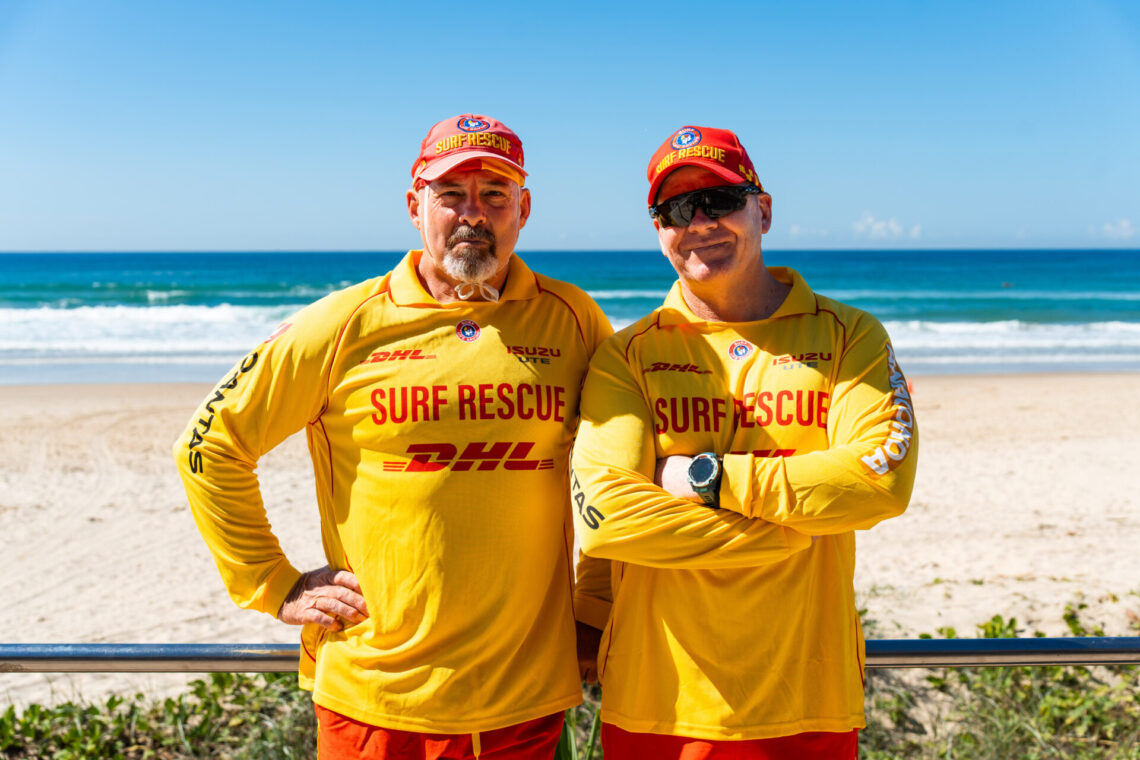
When Shane Leahy pulls on the red and yellow at Coolum SLSC, it isn’t the first uniform he’s worn. Shane joined the Navy as a medic in 1994, discharged in 2002, and spent the years after that feeling, in his own words, lost. It took a DVA support officer to point him toward his local surf club. Fifteen months on, he’s a peer support officer, a trainer and an active patrol member, and he says joining is the best thing he’s done since coming home.
Matt Neale’s story runs a similar course. Fifteen years in the Army, multiple deployments, an injury on operations that ended his career in 2004. When he moved to the Sunshine Coast, the mental health team supporting him suggested he join a surf club. He chose Marcoola SLSC.
“The volunteering aspect really grabbed me,” he says. “And the fact we still got to wear a uniform was really good.”
Stories like Shane’s and Matt’s aren’t the exception in Surf Life Saving Queensland. They’re closer to the rule, and they always have been.
A Movement Built by Service
Long before “veteran-friendly” was a phrase anyone used, surf lifesaving in Queensland was already full of returned servicemen finding their footing again. After the First World War, Maroochydore Swimming and Life Saving Club member Tom Prentis came home and set about rebuilding his club from the ground up, walking the district from Rosemount to Bli Bli to recruit new members and restore the ranks the war had thinned.
By the Second World War, that thread had only grown stronger. Nearly the entire active membership of Coolum SLSC, 32 members, served in the armed forces, and the club lost three of them. At Alexandra Headland, seven members fought at the Battle of Milne Bay, the first Allied victory over Japan, and four never came home. Jack Kuskopf, an Alex Headland member who survived Japanese captivity as a prisoner of war, returned to the club he’d left and went on to become one of its most respected instructors.
These weren’t separate chapters in two different stories. For generations of Queenslanders, military service and surf lifesaving have drawn on the same instinct: the willingness to put yourself between other people and danger, and to do it as part of a team you’d trust with your life.
That’s exactly what today’s veterans are finding when they walk through the clubhouse door.
Same Calling, New Uniform
Ask Shane or Matt what surf lifesaving has in common with the forces they served in, and the answer comes quickly.
“Communications, radio, comms, very simple and easy transition,” Shane says. “The camaraderie is a big one, and something that really stuck with me. You also find other veterans very quickly. We seem to suss each other out.”
Matt agrees. “Radio operations, risk assessments, managing emergencies, we’re already tuned into all of that. Surf lifesaving adds a few other bits and pieces, and we can implement them very easily with our existing skills.”
Neither of them started out as strong swimmers, and both are quick to point out that you don’t need to be. Matt failed his first attempt at the Bronze Medallion swim test, training on his own three days a week for eight weeks before passing “with flying colours.”
Shane is just as direct about it: “It’s not just about swimming. Lookouts, radio operators, these are perfect roles for defence members, especially those who’ve left due to injury. There is a role for everybody.”
What both keep coming back to is what the uniform gives them beyond the skills. “It gives you a sense of identity again,” Shane says. “That’s the one thing we miss when we leave the forces, we lose who we are. Surf lifesaving bridges the gap from military service to community service. You feel part of something again, you get back into a uniform, and you’re utilising your skills and experiences to do something good.”
Matt, who has around a dozen fellow veterans at Marcoola ranging from age 27 to their seventies, puts it even more plainly: “We’re all trying to get our fellow brothers and sisters into surf lifesaving, because it’s medicine. When veterans get out they can become reclusive. For those of us already in it, we’re big advocates for reaching out to our fellow servicemen and women.”
Introducing the Veterans in Surf Life Saving Network
That advocacy is exactly what Surf Life Saving Queensland wants to formalise and grow. This year, SLSQ is launching the Veterans in Surf Life Saving Network, a dedicated special interest group giving veteran members across the state a way to find each other, support each other and build a genuine community within our wider community.
The Network will bring veteran members together through a calendar of events designed for connection as much as capability: joint patrols where veterans from different clubs work a shift side by side, social catch-ups and barbecues, and structured opportunities to mentor veterans who are still finding their feet in a new club. Shane and Matt have already had a taste of what this can look like. At the end of the 25/26 season, eight veterans from across the region piggybacked onto a patrol at Kawana Waters Beach, a day Matt still counts among his best on patrol, not for what happened in the water, but for “opening the eyes of members there who didn’t even know veterans were involved in surf lifesaving.”
The Network will also work alongside RSL Queensland, building on the relationships many veteran members already bring with them, and will give clubs a clearer way to welcome veterans who might otherwise take eight months, like Shane did, to work up the courage to walk in the door.
Leading the charge is Alex Walker, SLSQ’s Member Experience Manager. “Every veteran who’s joined us so far has told us the same thing: the transition was smoother than they expected, and the camaraderie is what kept them there,” Alex says. “The Veterans in Surf Life Saving Network is about making sure no veteran has to find that out on their own. We want to give them a network before they even get to the clubhouse door.”
Zoe Bickerstaffe, SLSQ’s General Manager, Membership, says the Network reflects something the organisation has always known about itself.
“Our clubs have been shaped by service for well over a century, whether that was returned servicemen rebuilding their clubs after the wars or the veterans patrolling our beaches today,” she says. “This Network gives that connection a name and a home. We want it to grow into one of the strongest communities inside our movement, and we want every veteran in Queensland who’s ever worn a uniform to know there’s a place for them in this one too.”
How to Get Involved
Membership in the Veterans in Surf Life Saving Network is open to any current SLSQ member with a services background, and to veterans considering joining a club for the first time. New members who sign up will receive a limited-edition Veterans in Surf Life Saving Network goody bag and t-shirt as a welcome to the group.
If you’re a veteran, or you know one who might be looking for their next mission, this is the invitation.
As Shane puts it: “Just do it. It’s the best thing I’ve done since I’ve been back.”