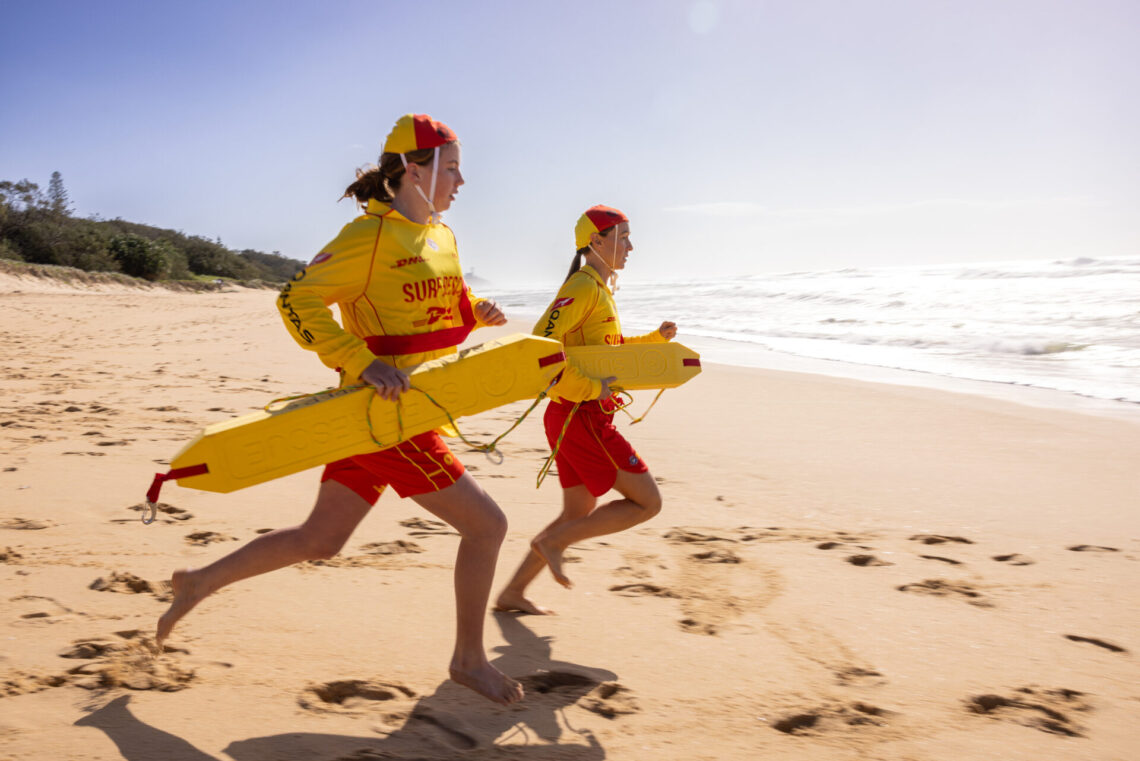
There is a piece of equipment on every Australian patrol that most people walk straight past without a second thought. It sits coiled at the patrol, worn across the chest of a lifesaver heading into the water, or clipped ready at the patrol tent. Yellow, flexible, deceptively simple. The rescue tube has become so familiar that it barely registers — and yet its story stretches back nearly a century, crossing the Pacific and transforming surf lifesaving in ways that are still felt every patrol day.
Before the Tube, There Was the Reel
To appreciate the rescue tube, you first need to understand what it replaced.
Australian surf life saving was built on a uniquely local invention — the belt and reel. Invented in 1906 by Lyster Ormsby, Percy Flynn and Sig Fullwood, the surf reel was a giant drum of rope mounted on a wooden frame, planted in the sand at the water’s edge. A lifesaver would strap on the belt, take the rope, and swim out through the surf to reach a person in trouble. The crew on shore would then haul them both back in.
It worked. It saved lives. And it required five people to operate it properly.
Every rescue was a team operation. You needed the beltman in the water, linemen keeping the rope clear, and someone managing the reel. It was a system designed for the era — an era when lifesaving was conducted in military-style formations, with drills, precision, and manpower.
The reel remained Australia’s primary ocean rescue tool until the early 1980s, though its decline had begun well before then. It lives on today in surf sport competition with Surf Belt Races being one of the more prestigious events conducted with the Rescue and Resuscitation event and the March Past as a reminder of where it all started.
A Californian Invention That Changed Everything
While Australian lifesavers were mastering the reel, something different was being developed on the beaches of Santa Monica, California.
Preston “Pete” Peterson was nineteen years old and already California’s most gifted board rider when he started thinking seriously about lifesaving equipment. A craftsman and innovator by nature — he also built high-performance surfboards and paddleboards from balsa and redwood — Peterson saw a problem with how lifeguards were entering the water. There was no easy way to control a panicked victim once you reached them. You were swimming, they were struggling, and the physics of the situation were working against you.
His solution was an inflatable rescue buoy with snap hooks moulded onto one end and a short strap on the other. The lifesaver wore a harness attached by a line, swam the device out to the victim, and then wrapped it around them — creating immediate buoyancy for two people, freeing the rescuer’s hands, and allowing them to tow the victim back to shore with far greater control.
By 1935, Peterson had a working prototype that would go into production. It was immediately recognised as a significant leap forward in ocean rescue. There was criticism early on — the inflatable construction meant it could and did deflate during rescues, a serious flaw in emergency conditions — but the concept was sound. A solo lifesaver could now enter the water, reach a victim, and effect a rescue without any shore-based support.
The problem of deflation was solved in the late 1960s when closed-cell foam rubber replaced the inflatable core. The modern rescue tube was born. It couldn’t puncture. It couldn’t deflate. And it floated reliably enough to support the weight of a rescuer and multiple victims simultaneously.
The Moment the Tube Arrived in Australia
The rescue tube made its Australian debut through one of the most significant exchanges in international lifesaving history — a tour that also, almost incidentally, introduced the Malibu surfboard to this country.
When American lifesaving teams visited Australia in the 1950s and 60s, they brought their equipment with them. Australian lifeguards, who had depended entirely on the belt and reel, saw the Peterson tube in action for the first time. It was quickly adopted by professional lifeguards, though the volunteer surf lifesaving movement — which had deep cultural and institutional ties to the reel — made the transition more gradually.
By the 1970s, rescue tubes were beginning to replace surf reels in active patrol use. Through the 1980s and 1990s, they became standard issue across Australian clubs, sitting alongside the rescue board and the newly arrived inflatable rescue boat as the foundation of modern patrol capability.
The shift was profound. What had required a team of five and a heavy piece of shore-based machinery could now be accomplished by a single lifesaver who could run into the water, swim to a victim, and bring them back — all with a device that weighed next to nothing and could be carried on their body.
What the Tube Can Actually Do
Beyond the technical side of the event, it is worth pausing on what the rescue tube makes possible, because it is more than just a floating device.
A trained lifesaver can throw the tube to a conscious victim in distress, allowing them to grab hold and be towed back. They can wrap it securely around an unconscious victim to keep their head above water during the return journey. Remarkably, the tube provides enough buoyancy to support both rescuer and victim, meaning expired air resuscitation can be performed in open water — keeping a non-breathing patient alive before they even reach shore.
The tube unrolls automatically when the rescuer enters the water, trails behind on a leash connected to a shoulder harness, and stays out of the way until it’s needed. The clip system allows it to be secured around a victim quickly and under pressure. In Australia, every rescue tube used in official patrol must meet SLSA specifications — minimum buoyancy of 100 newtons in freshwater, closed-cell foam construction, and webbing rated to withstand more than 450 kilograms of stress. The design looks simple. The engineering behind it is anything but.
A Century of Saving Lives
More than 550,000 people have been rescued by Australian surf lifesavers since the movement began in 1907. The rescue tube has been part of that story for the better part of fifty years, quietly and reliably doing the job it was designed to do.
It is one of those rare pieces of equipment that solved its problem so well that it has barely needed to change. The materials are better. The standards are higher. The training that surrounds it is more sophisticated. But the fundamental concept — a single rescuer, a flexible floating device, a harness and a line — is essentially what Pete Peterson worked out on a California beach in 1935.
Every lifesaver who clips on their shoulder strap and heads into the surf is carrying that history with them. It’s easy to overlook a piece of equipment you see every patrol day. But the rescue tube earned its place on the beach — and it continues to earn it, rescue by rescue, season after season.