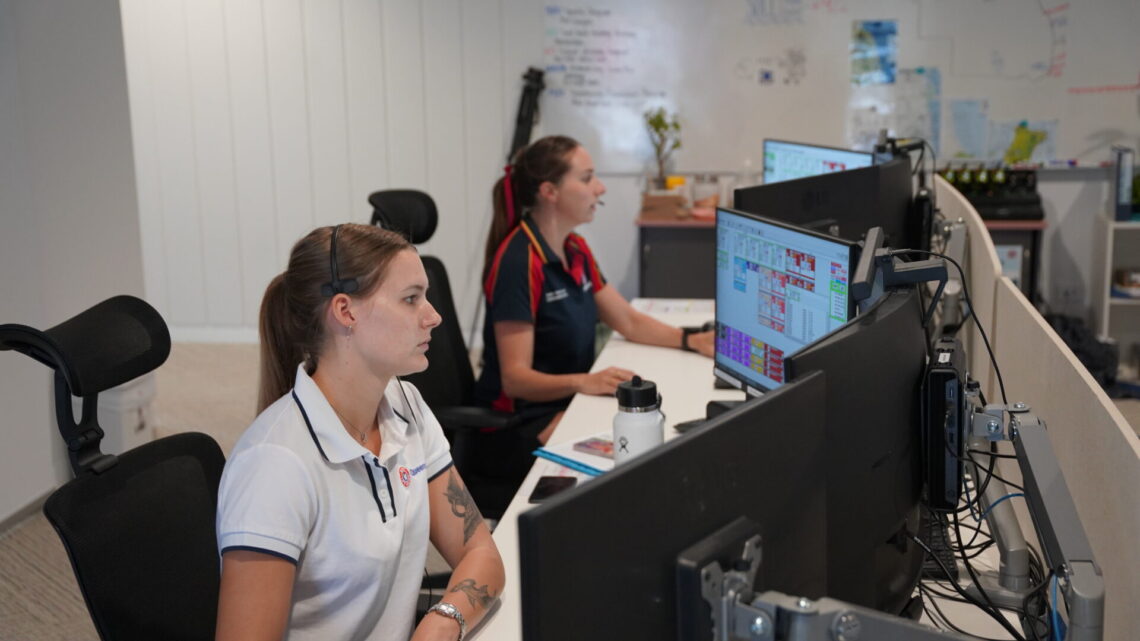
While patrolling members keep watch on the sand, another team (who you don’t see) work tirelessly behind the scenes to keep our coastline safe – the State Operations and Communications Centre (SOCC).
From its new and improved Gold Coast base, the SOCC serves as the operational backbone of Surf Life Saving Queensland by supporting daily patrol operations, coordinating responses, and providing the critical communication link that helps keep beachgoers safe.
To learn more about the vital role the SOCC plays in keeping our beaches safe, we spoke with Kate Wake, SLSQ’s SOCC Supervisor on the Gold Coast, about what goes on behind the scenes, the teamwork that drives the centre, and how moments of inclusion are shaping the future of lifesaving operations.
“The SOCC plays a vital role in supporting Surf Life Saving Queensland’s operational readiness and coastal safety management,” explains Kate. “On a day-to-day basis, the SOCC oversees the business-as-usual (BAU) operations that ensure the effective coordination and delivery of lifesaving services across the state.”
Coordinating the Coast
Operating seven days a week, the SOCC acts as the central coordination hub for surf lifesaving operations across Queensland.
“Its role becomes particularly crucial during peak seasons, public holidays, and major incidents when visitor numbers and operational demands are at their highest,” Kate says.
“It’s proactive oversight, coordination, and communication capabilities are critical in preventing loss of life, supporting frontline lifesavers and lifeguards, and ensuring that every beachgoer enjoys a safe coastal experience.”
The SOCC also has an important role when our people are responding beyond the flags and beyond the break, with an increasing role supporting and coordinating SLSQ resources during times of disaster under our SLSQ Disaster Management Plan (SLSQ DMPLAN).
Volunteers Behind the Scenes
Many of the SOCC’s operators are volunteers drawn from within the surf lifesaving community — members who bring their frontline knowledge and experience to a new kind of patrol.
Before starting shifts, volunteers complete specialised training covering communication protocols, incident management, and SLSQ’s operational systems.
“Once trained, they play an essential role in keeping Queensland’s beaches safe — logging incidents, supporting coordination during major events, and maintaining that crucial communication link between the beach and the wider network.”
Women Leading the Operations
As women continue to grow their presence across operational and leadership roles within the SOCC, a recent shift stood out as a powerful milestone.
For the first time, an all-female crew was rostered to control and operate the centre.
“Seeing an all-female crew operating the SOCC is both inspiring and deeply meaningful to our team. It represents the continued growth of diversity, inclusion, and leadership within SLSQ,” Kate says “It also serves as a powerful example for younger members and aspiring lifesavers. It shows that there is no limit to where passion and commitment can take you within Surf Life Saving — whether that’s on the beach, in the communication centre, or in leadership and coordination roles.
Kate believes visibility like this plays a vital role in encouraging more women to pursue operational and leadership positions within lifesaving.
“For many members, especially younger women or new volunteers, seeing an all-female team running the SOCC serves as both representation and motivation. It fosters a sense of belonging, shows clear pathways for advancement, and strengthens confidence to step forward into roles in coordination, communication, and incident management” she says.
“Leadership in lifesaving is defined by skill, capability, and teamwork — not gender.”
Advice for aspiring volunteers
For those considering volunteering in the SOCC, Kate describes the role as both rewarding and deeply meaningful.
“My advice to anyone considering volunteering in the SOCC is to take the time to understand what the role truly involves. It’s a rewarding position, but it’s also one that demands focus, emotional resilience, and the ability to perform under pressure.”
For those who thrive in dynamic environments and are passionate about contributing to lifesaving operations in a meaningful way, this role is for you.
Kate explains that “you gain a unique perspective on how our patrols, clubs, and support services come together to keep the public safe — and you play a direct role in that success every day.”
Opportunities will be increasing in the new year as the SOCC expands its capability into the Sunshine Coast, with a second facility operating to cater for increasing demand.
“We are one SOCC that will soon be operating across two locations, which will provide increased volunteering opportunities and also provide network redundancy,” said Kate
The “Glue” That Keeps us Connected and Coordinated
Behind every patrol, every rescue, and every call for help, the SOCC is there – guiding responses, connecting teams, and ensuring help is never far away. It’s a reminder that lifesaving extends far beyond the beach, and that every voice, every volunteer, and every moment of teamwork contributes to one shared mission: keeping Queensland’s beaches safe.